
Three Sources Behind Liberty County Property Value
Naming the number comes first in any Liberty County property value search. The Board of Assessors publishes valuation figures in its annual assessment notice. That approved assessment drives taxation. A tax bill, though, is its own record. Recorded deeds and PT-61 material may carry transfer consideration instead. None of these sources reflects a fresh arm's-length sale. It will not tell you what the property would fetch today.
| Value type | Meaning | Official source |
|---|---|---|
| Fair-market or appraised value | The assessor's expected-sale-value basis for the notice year | Board of Assessors NOA |
| Assessed value | Georgia's assessment level applied to fair-market value | Board of Assessors NOA |
| Net taxable value | Value remaining after approved exemptions or special treatment | Assessment notice and digest |
| Sale consideration | The amount or transfer-tax information associated with a conveyance | Recorded deed and PT-61 trail |
Georgia generally sets assessed value at 40 percent of fair-market value. Liberty's notice also separates taxpayer-returned, previous, current, covenant, exemption, and net taxable figures. A deed consideration amount can stem from a gift. It can also come from an estate transfer, a family deal, a partial interest, or a nominal sum. These figures can disagree. That does not make any record wrong.
Liberty County Assessment Notice Value Labels
The county's 2025 notice explanation gives a more useful inventory than a generic estimate. It identifies ownership as of January 1 and can display taxpayer-returned value, previous value, current value or expected sale price, 100 percent appraised fair-market value, 40 percent assessed value, other or covenant value, exemptions, net taxable value, and estimated rollback millage. Read each label with its notice year.
| Notice field | What to record |
|---|---|
| Returned value | The owner's submitted opinion, if one was filed |
| Previous and current value | The assessment-cycle comparison |
| 100% FMV | The appraised fair-market basis |
| 40% assessed value | The standard Georgia assessment level |
| Exemptions and net taxable | The relief applied and remaining taxable base |
This layered display protects against collapsing everything into "the county value." Keep a simple worksheet listing source, record year, effective date, field label, and amount. Changes across assessment cycles become visible. Just avoid reading the difference as market appreciation.
Find a Liberty County Property Value by PIN
The Liberty County Property Information System, or PRISYM searches parcels by Parcel Number or Owner Name. It also covers site addresses by Full Address or Full Road Name, and subdivisions by Name. Use it to identify the current PIN. Then open the county's official assessment-document screen. The PIN unlocks the record card or annual notice there. The Liberty County property portal provides another official entry point for property records.
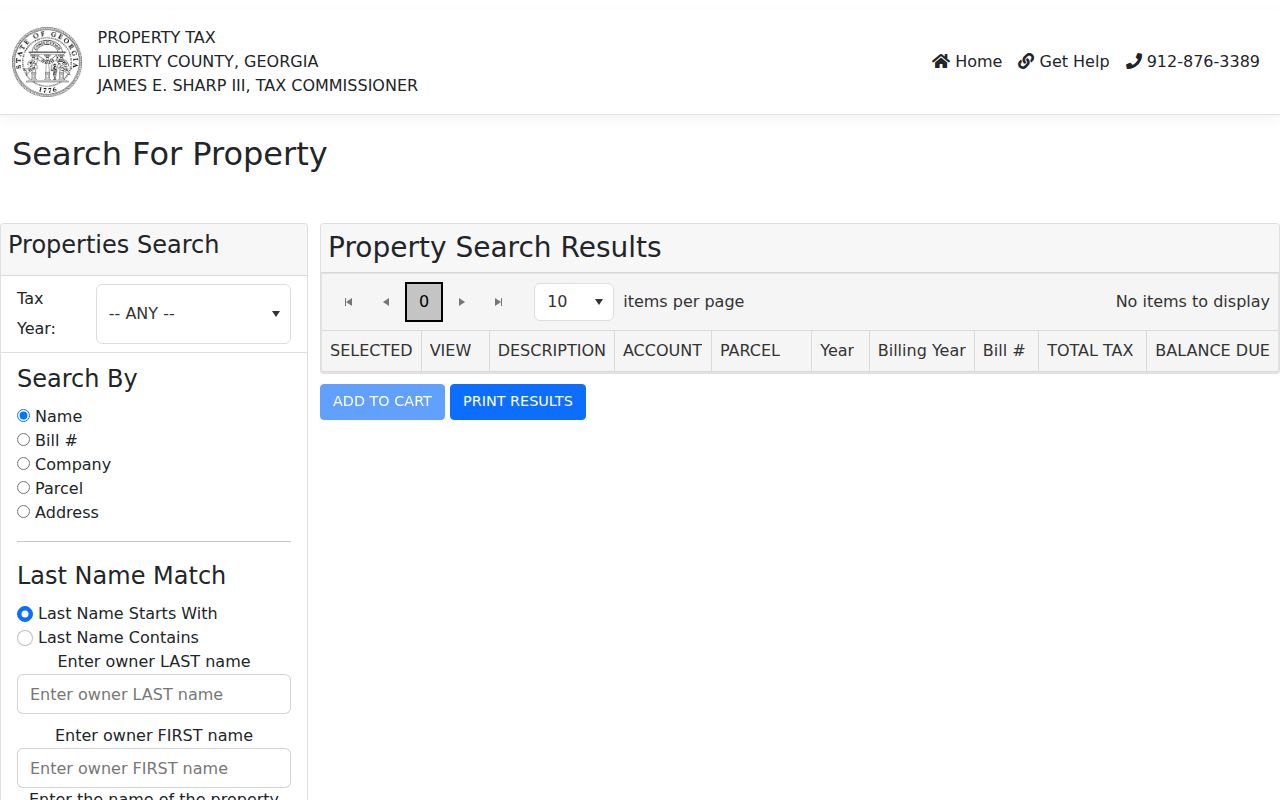
Pair the live portal with the dated assessment notice. A working display and an annual document can reflect different update points.
- Search the full address in PRISYM and select the matching parcel polygon.
- Save the current PIN, Old PIN fields, property address, tax district, and legal-description clues.
- Enter the PIN on Official Assessment Documents and choose the PRC or NOA needed.
- Write down each value label, amount, year, and exemption line exactly.
- Search the Clerk's deed index only when a recorded transfer amount is relevant.
- Assessed value
- The statutory portion of the appraised fair-market value.
- Fair-market value
- The assessor's mass-appraisal estimate for the stated cycle.
- Assessment ratio
- The relationship between assessed and full fair-market value, generally 40 percent in Georgia.
- Consideration
- The value or amount associated with a recorded transfer, which may not be an open-market price.
- Reassessment
- A new cycle determination that can change the official value fields.
View the Liberty County assessment-document screen represented in this capture.
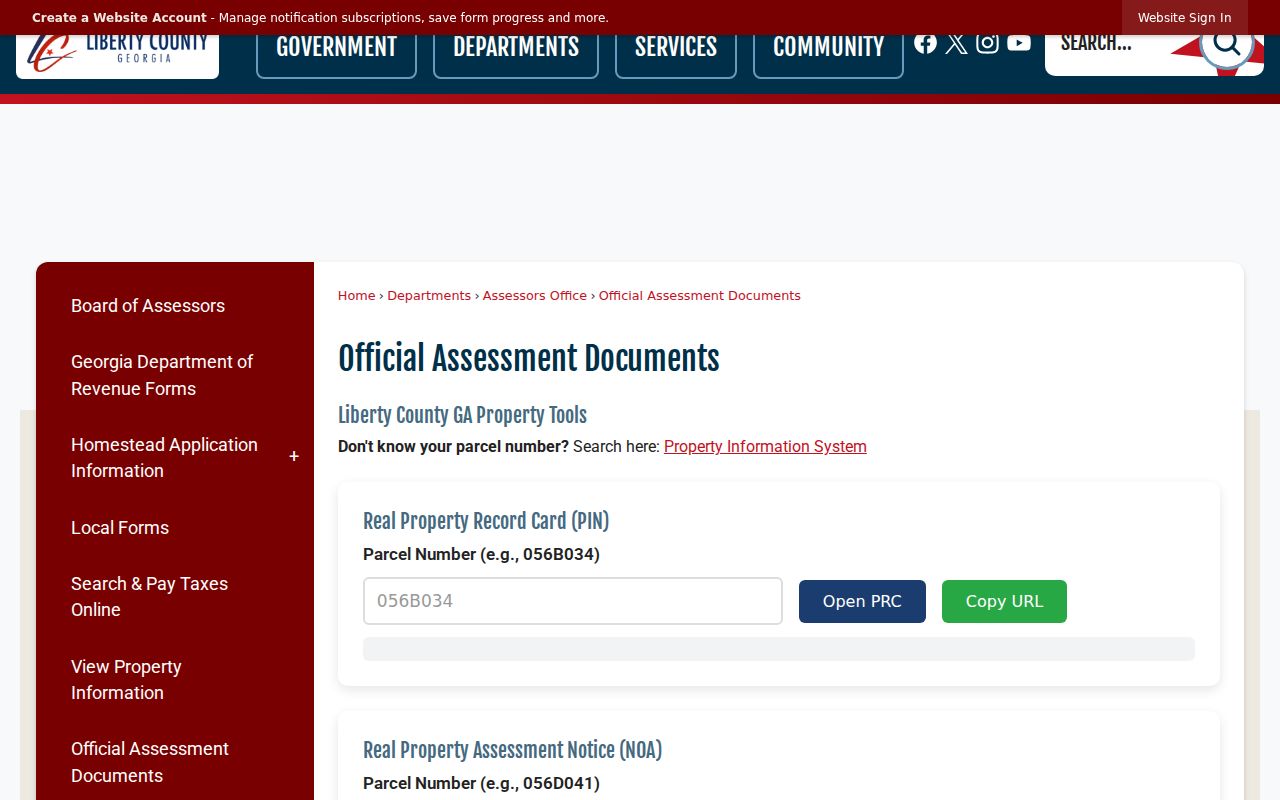
The portal screen shows why the record card and notice serve different purposes. The PIN is the common key linking both records.
Georgia's 40 Percent Rule in Liberty County
The Georgia Department of Revenue valuation guide lays out the statewide framework. Counties generally assess real property at 40 percent of fair-market value. Picture a Liberty County NOA listing $100 in full appraised value. The standard ratio yields $40 in assessed value before exemptions or special treatment. That is a ratio illustration only. It describes no real parcel.
Current-use and qualifying agricultural property follow special rules. State material describes a 30 percent level for certain agricultural property. Covenant value can also appear separately on the notice. Never apply a special category just because land looks rural on a GIS map. Confirm enrollment, classification, and the live record with the Board of Assessors.
Note: Liberty County assessed value is a calculation stage. Net taxable value reflects approved adjustments that follow it.
Recorded Sale Consideration in Liberty County
The Liberty County Clerk of Superior Court records deeds and related real-estate instruments. GSCCCA supplies the statewide index and PT-61 framework. A name, book and page, instrument type, property location, and recording date can all lead to the conveyance. A name search works. So does a book and page lookup. The figure tied to the deed is useful evidence of a transaction. Label it "consideration" unless the record establishes an arm's-length sale price.
Family deeds, gifts, estate distributions, nominal transfers, partial interests, and covenant transactions can all produce amounts far from open-market value. Family deeds often carry token amounts. Gifts and estate distributions do too. Recording date and assessment date differ, too. For an ordinary value comparison, set deed consideration beside the same year's assessor FMV. Then describe why the sources differ. Averaging them helps no one.
January 1 Dates Liberty County Value Records
January 1 anchors Liberty County assessment ownership. A closing later in the year can leave the annual tax roll showing the prior owner of record. The deed records the new grantee even so. The value and owner lines stay tied to that assessment date. When a sale is recent, lay four dates side by side: the deed recording date, the January 1 ownership date, the notice date, and the date the parcel first appears in the portal.
Timing matters just as much along Hinesville's 2024 annexation edge. A city boundary, a tax district, a postal city, and a parcel record can each refresh on different dates. A newer city label alone does not signal a value change. A value change alone does not prove annexation caused it. Note what each source actually reports. Ask the office responsible to explain its own field.
Exemptions Change Liberty County Taxable Value
Exemptions change the taxable side only. Homestead, elderly, disabled-veteran, surviving-spouse, and current-use programs shrink how much of a Liberty County assessment stays taxable. They never touch the fair-market estimate itself. Read the NOA closely. Check the exemption entries and the net taxable amount. Both sit after the 100 percent and 40 percent fields. That separation matters. The tax roll only taxes part of it.
The Board of Assessors approves every exemption. That office can confirm current applications, filing periods, documentation, and status. The Tax Commissioner's payment screen decides nothing about exemption eligibility. For tax bills, exemption procedures, and appeals, use the Liberty County property tax records guide. Value research stops at the meaning and source of the numbers.
Planning News Does Not Set Liberty County Value
Planning documents draw a lot of attention. Liberty County's 2025 joint comprehensive-plan materials sketch future land-use policy, and a proposed 2026 Unified Development Ordinance amendment may reshape it further. Neither sets an official property value. Neither proves an enacted parcel restriction either.
Before citing a planning document in a value discussion, check the current zoning map, the ordinance's status, and the parcel record. Map overlays deserve the same care. Flood, wetland, zoning, and imagery layers can prompt due diligence, yet the assessor's NOA remains the source for the county's recorded valuation fields. A professional appraisal weighs market evidence and physical condition in a way a planning layer cannot.
Get Liberty County Value Records Offline
When the PRC or NOA will not load, reach the Board of Assessors directly. Call 912-876-3568, email Tax.Assessors@libertycountyga.gov, or visit the Hinesville office. Have the parcel PIN, the address, the notice year, and the exact document type ready. The official materials list weekday office access. The public screen is never the only route to the record.
An older assessment file may not be routinely posted. File a narrow Liberty County Open Records request for it. Georgia agencies generally produce records within three business days. They can instead state availability, timing, cost, and any exemption. They do not have to build a new valuation analysis. Request a named existing record instead. A specific year's NOA, PRC, or assessment correspondence works.
Limits of a Liberty County Property Value
An assessor's number is mass appraisal for public assessment. It may not reflect condition on the search date. It misses private concessions, unique uses, and buyer judgment. A deed consideration figure only records a transfer, and it can be nominal or non-market. Neither number promises what a new buyer will pay.
For a professional opinion of current market value, hire a licensed appraiser. Informal due diligence still goes far: compare well-labeled official values across years, verify the parcel identity, and research whether a transfer was arm's length. Never present an assessment, a tax amount, or an automated online figure as an appraisal.
Value is not price. A Liberty County assessed value supports taxation; it is not a prediction of sale price or a licensed appraisal.