
Read the Deed Types Recorded in Liberty County
Deeds and their kin are recorded by the Real Estate Division of the Liberty County Clerk of Superior Court. GSCCCA then republishes the participating index statewide. One search can reach both counters. The label on an instrument still matters, though, because not every deed carries the same promises, and a security deed or a release documents an encumbrance rather than a transfer of ownership.
| Deed Type | What It Does | Common Use |
|---|---|---|
| Warranty deed | Conveys the described interest with stated title covenants. | An arms-length conveyance may use this form. |
| Quitclaim deed | Conveys whatever interest the grantor has without promising that interest is valid. | Family transfers and title cleanup. |
| Gift deed | Transfers property as a gift rather than an ordinary sale. | Family or estate planning transfers. |
| Executor or trustee deed | Shows a fiduciary acting under estate, trust, or legal authority. | Estate and trust administration. |
| Tax deed | Documents a transfer arising from the tax-sale process. | Delinquent-tax proceedings. |
The label tells only part of the story. Read the granting language itself. Check the legal description, the execution, and the recording stamp before trusting what a list calls the document. A security deed, assignment, cancellation, lien, release, lis pendens, or plat can be essential to a parcel's history, yet none of them serves the same function as the ownership deed.
Search Liberty Deed Records by Name
A deed search with a known party starts at the GSCCCA real-estate name search. Pick Liberty County from the list. Then decide: grantor, grantee, or both. Filtering by instrument type and recording dates strips out irrelevant hits without breaking the chain.
| Search field | How to use it | Reason to vary it |
|---|---|---|
| Party type | Choose grantor, grantee, or the available combined route. | A person can appear on opposite sides of different transfers. |
| Instrument type | Limit to the relevant deed or related document class. | Assignments, liens, and releases can crowd a broad name search. |
| County | Select Liberty; add neighboring counties only when facts justify it. | The statewide database otherwise produces unrelated people. |
| Name | Try exact legal and reasonable indexed variations. | Initials, entity suffixes, trustees, and estates vary. |
| Date range | Bracket the likely conveyance, then widen. | A tight range can hide an earlier acquisition deed. |
| Results per page | Choose a workable table size. | Common names may return many entries. |
A single results entry can pack in party name and type, instrument type, county, recording date, book and page, instrument number, cross-reference, property description, and image availability. That is a lot of detail. Save that citation either way, even when the image is not immediately viewable.
The official GSCCCA search form shows the actual fields used for Liberty County deed records.
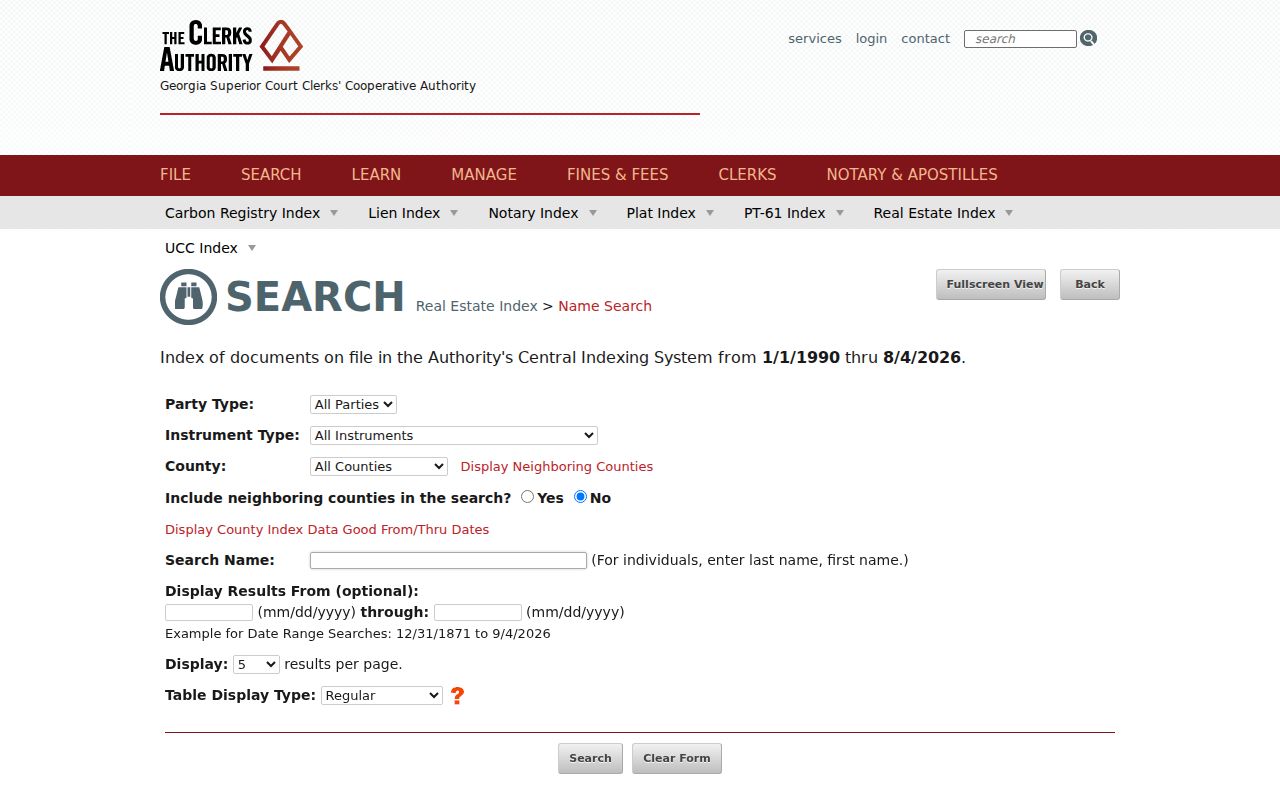
The form keeps party, instrument, county, name, and date in separate controls. That structure rewards discipline over a broad name query.
Retrieve a Deed by Book and Page
An index entry hands you a citation. The next stop is the GSCCCA book/page search. Only three fields matter there: county, book, and page. This is the direct retrieval route, and it spares you guessing through repeated names. Hang on to the instrument number and cross-reference too, since a later filing may point back to an earlier one.
Confirm before ordering a copy. The deed should name the expected parties and describe the expected land. Addresses are just search clues. The legal description, parcel hints, subdivision and lot references, and the prior-deed citation carry the land's identity, and a deed can cover more or less land than the current tax parcel.
The book and page interface shows why the citation is the durable bridge between an index result and the document itself.
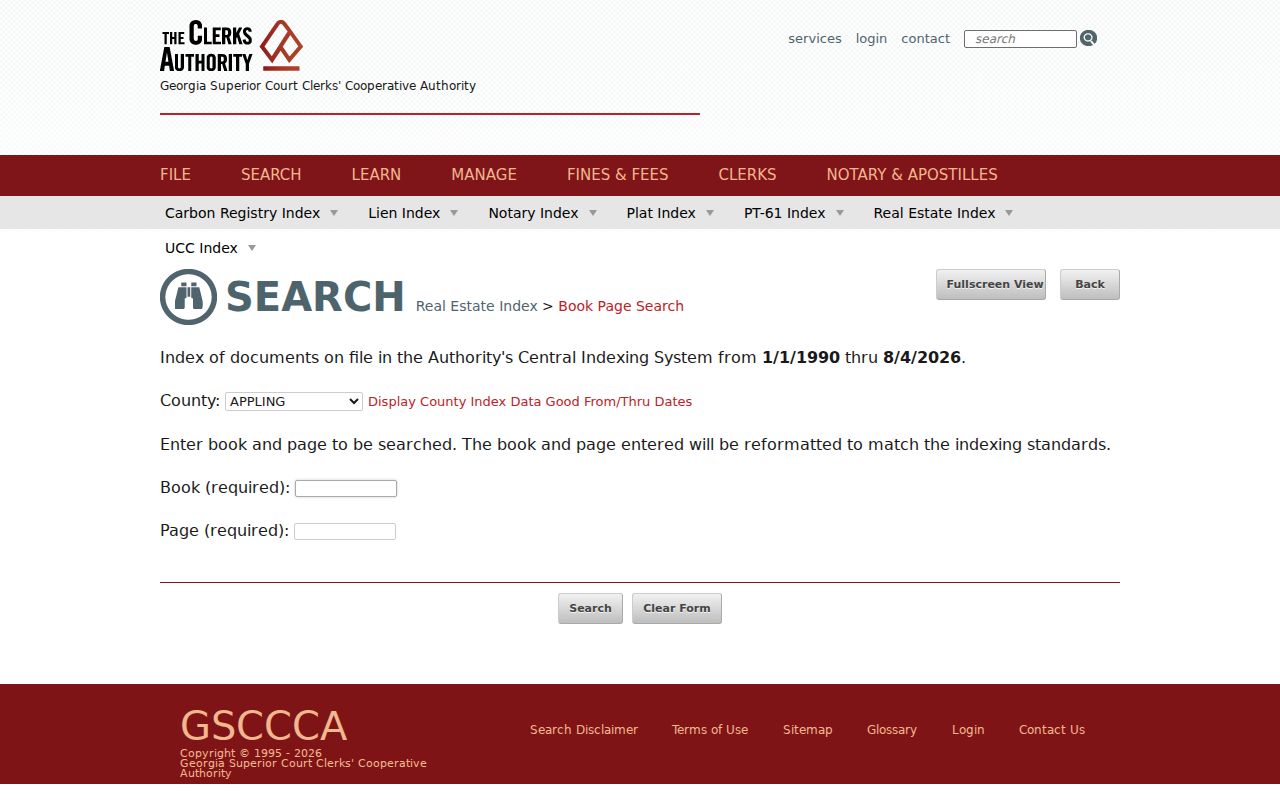
The lookup shrinks once the details are in hand. A county plus the recorded book and page pair is all the form really needs.
Follow Liberty County's Grantor-Grantee Chain
A chain of title is built by reading deeds as linked evidence. Start with the newest confirmed acquisition instrument. A tax screen's owner text is not the same. At every step, preserve the party names, deed type, recording date, legal-description clue, and the book/page or instrument number.
- Identify the current acquisition deed by searching the present owner as grantee and matching the land description.
- Read the grantor from that instrument and note any prior-deed citation.
- Search that grantor as an earlier grantee, then match the same tract rather than merely the same surname.
- Repeat while recording gaps, parcel changes, estates, and cross-references; move to local books or archival images when the online range ends.
- Grantor
- The party conveying the stated interest; often, but not always, a seller.
- Grantee
- The party receiving the stated interest.
- Chain of title
- The linked sequence of instruments affecting title to the same land.
- Book/page and instrument number
- Recording citations used to retrieve or cross-reference a filed document.
Know Liberty's Two Online Cutoffs
Keep the two coverage statements separate. GSCCCA's statewide real-estate index runs from January 1, 1990 through the current date the service displays, and historical data for 1993 through 1998 is still being added. The Liberty Clerk reports in-office digital images and index data back to 1976. Neither number is a coverage guarantee. A home computer may still not reach every earlier instrument.
Treat the mismatch as a warning. Do not smooth it over. A negative result can reflect an incomplete statewide index, a misspelled name, an entity or estate entry, or material held only in the office and the older books. The Clerk's historical project is recreating Liberty land records from 1789 through 1991. That project makes local access unusually important here. The older books still answer questions the index cannot.
Note: Record the database, search date, names, and date range whenever a negative result may matter to later research.
Reach Older Liberty County Deed Books
Earlier ownership work pairs the Clerk with archival tools. The FamilySearch catalog identifies Liberty deeds and mortgages covering 1808 through 1904. Its image access carries restrictions. A FamilySearch center or affiliate library may be required. The Georgia Archives research guide points researchers to county microfilm indexes and FamilySearch resources, and the Georgia Virtual Vault carries Liberty County finding material as well.
Old place names help an older search. Liberty's county seat moved from Sunbury to Riceborough in 1797 and then to Hinesville in 1837. Old records may name a former seat. Newspapers, probate files, and deeds can carry plantation, community, or road names. Match land lots, districts, metes-and-bounds language, neighbors, and book/page references instead of forcing a modern street address onto an old record.
Liberty County has no recorded courthouse-fire or destroyed-book chronology. Do not blame gaps on a fire. Incomplete indexing, unscanned books, access controls, spelling changes, estates, and parcel changes explain them well enough.
Watch New Filings With Georgia FANS
Georgia's Filing Activity Notification System is a free alert tool for deed-record monitoring. Known as FANS, it notifies a registrant of new filings. The filing must match a name or address on file. Think of it as a lookout for future recordings. It looks forward only. Each enrollment lapses after one year and must be renewed to keep the alerts coming.
A Liberty County owner of record can use it to catch activity. That activity may deserve a closer look. Still, it is no substitute for a deed search. Name matching is loose, common surnames trigger false alarms, and delivery timing varies. Treat it as a complement, not a complete title watch.
An unexpected alert deserves a calm response. Pull the referenced instrument and contact the Clerk through official channels. Never assume fraud from a match alone. The FANS enrollment screen is the official place to sign up.
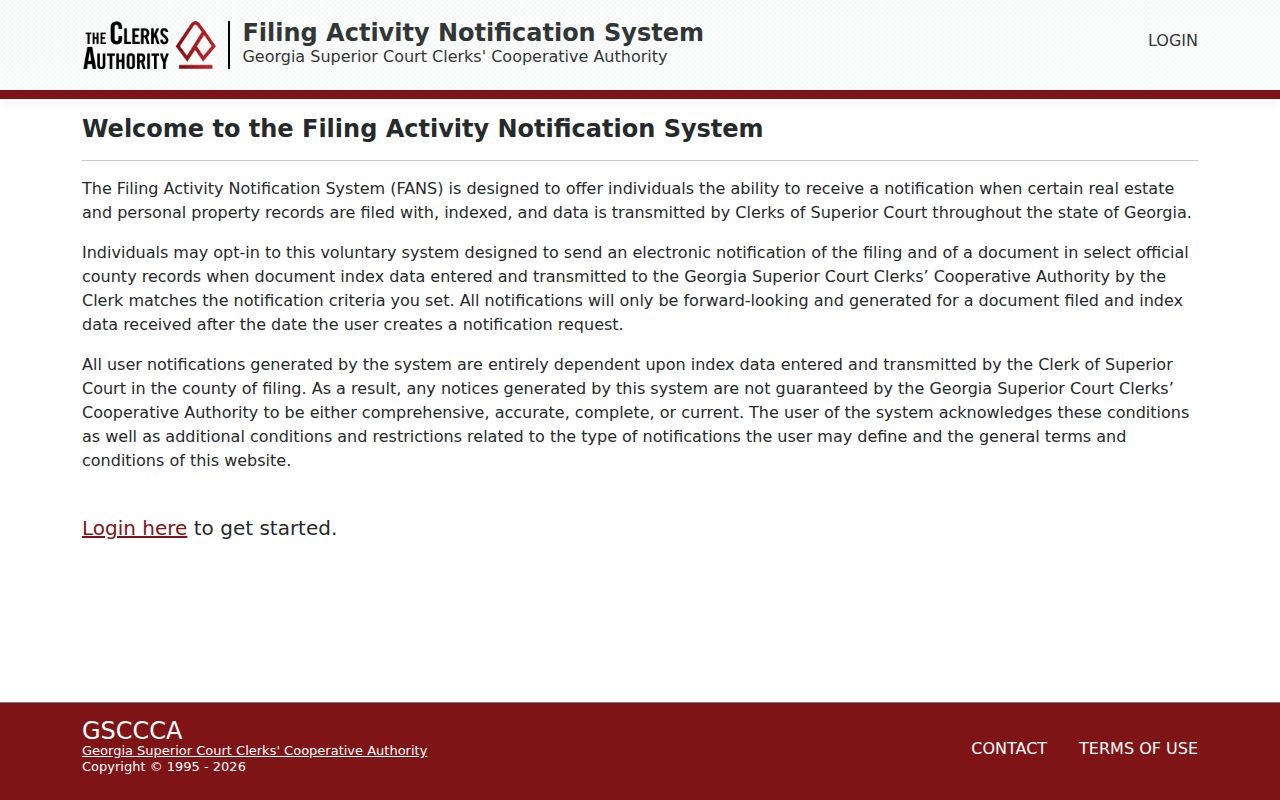
For Liberty County deed records, FANS works alongside periodic searches by watching new submissions tied to registered names or addresses.
Separate Deeds From Liens and Plats
A thorough Liberty County property search does not end with one deed. Security deeds and assignments reveal financing. Cancellations and releases show how an encumbrance ended. A lis pendens flags litigation touching the land. Search each category through the GSCCCA lien index. It offers both name and book/page routes. Recorded plats live in the separate plat index.
Tie every associated document to the same parcel. Match by legal description, book and page, party names, and dates. A parcel number helps but has limits. Older deed records may predate the current PIN, and some cover a larger parent tract. Search mechanics for parcels appear in the Liberty County property search.
Obtain a Liberty County Deed Copy
Index access and document copies are two different services. A no-fee, limited-use GSCCCA account covers index and summary lookups. A regular account runs $14.95 per calendar month, with viewable images and printed pages at $0.50 each. Review the limited-use account terms and the current image charges before paying.
The Clerk of Superior Court offers the local route. The office sits at 201 South Main Street, Suite 1200, Hinesville, Georgia 31313, and answers at 912-876-3625. The counter handles the in-office digital index, older deed records, and certified copies. Bring names, document type, recording date, and the book/page or instrument number. Ask about plain-copy and certification fees first, since purpose and page count drive the cost.
A deed that resists ordinary channels can surface through a county Open Records request. Name the record, its dates, the parties, the citation, and a preferred delivery method. The office cannot invent a new record. So describe an existing deed or index entry as precisely as you can.
Recorded, not guaranteed. Liberty County deed records show instruments accepted for recording; they do not establish that every interest was recorded or provide a legal title opinion.