
Trace Liberty County Owners Backward
Start with a real deed, not a guess. Copy each transfer into its own row. One deed's grantor should appear as the grantee in an earlier deed for the same land. Legal description, lot, acreage, and book and page guard against a same-name mistake in Liberty County property records.
| Transfer Date | Grantor to Grantee | Deed Type | Book/Page |
|---|---|---|---|
| Newest matching recording | Prior owner to current grantee | As indexed | Copy exact citation |
| Next earlier acquisition | Earlier owner to prior owner | As indexed | Copy exact citation |
| Earlier book entry | Earlier grantor to earlier grantee | As written | Local or archival citation |
The timeline stays blank by design; the county's live index offers no ready-made prior-owner example. Never invent names, dates, or deeds to fill it.
Read Liberty Deed Party Roles
The grantor conveys an interest in the land. The grantee receives it. Those two roles drive a former-owner search in Liberty County, though instrument type matters too, since warranty, gift, estate, trustee, quitclaim, and tax-sale deeds carry different promises and stem from different events.
- Grantor
- The party who conveyed the interest.
- Grantee
- The party who received it and becomes the next backward-search key.
- Chain of title
- The linked sequence of instruments affecting the same land.
- Reverse index
- An index used to find a receiving party's earlier acquisition.
- Quitclaim and warranty deed
- A quitclaim lacks the same title promises carried by a warranty deed.
Not every recorded document transfers ownership. A security deed, release, lien, easement, or plat may still affect Liberty County land, so keep each one beside the ownership line rather than inside it as a false sale.
Reconstruct Liberty's Prior Owner Chain
The GSCCCA name search spans Liberty and neighboring counties. Individuals go in last name first. Party, instrument, and date filters narrow the results, while initials, married names, entity suffixes, trustee wording, and estate styles catch deed entries hiding under variants.
- Use the present parcel and owner to find the latest deed where the owner appears as grantee.
- Read the grantor, date, type, legal description, and book/page.
- Search that grantor as a grantee in earlier years and match the acquisition deed to the land.
- Repeat, then audit forward so each transfer connects or a documented estate, trust, or court event explains the break.
A citation opens the book/page search. Old deeds rarely list a modern address. Lot, block, land lot, district, metes and bounds, and acreage become the tests that tie a deed to a Liberty County parcel.
How Far Liberty Owner Records Reach
The GSCCCA central index opens on January 1, 1990. The Liberty Clerk separately reports in-office digital deed images and index data back to 1976. One county recreation project spans 1789 through 1991. The ranges overlap because each source describes a different product, so a gap in one does not mean the deed is lost.
Know the cutoff. Statewide indexed access starts in the 1990-era range shown live; older prior owners may require the Clerk, deed books, microfilm, or archives.
Older Liberty deed books live at the counter. Staff can pull them for you. The Clerk's Real Estate Department at 201 South Main Street, Suite 1200, Hinesville, opens weekdays 8:30 a.m. to 5:00 p.m., and copies cost $0.50 per page unaided or $1.00 with help.
Liberty's Uneven Digital Timeline
The manifest supplies the GSCCCA grantor-grantee screen.
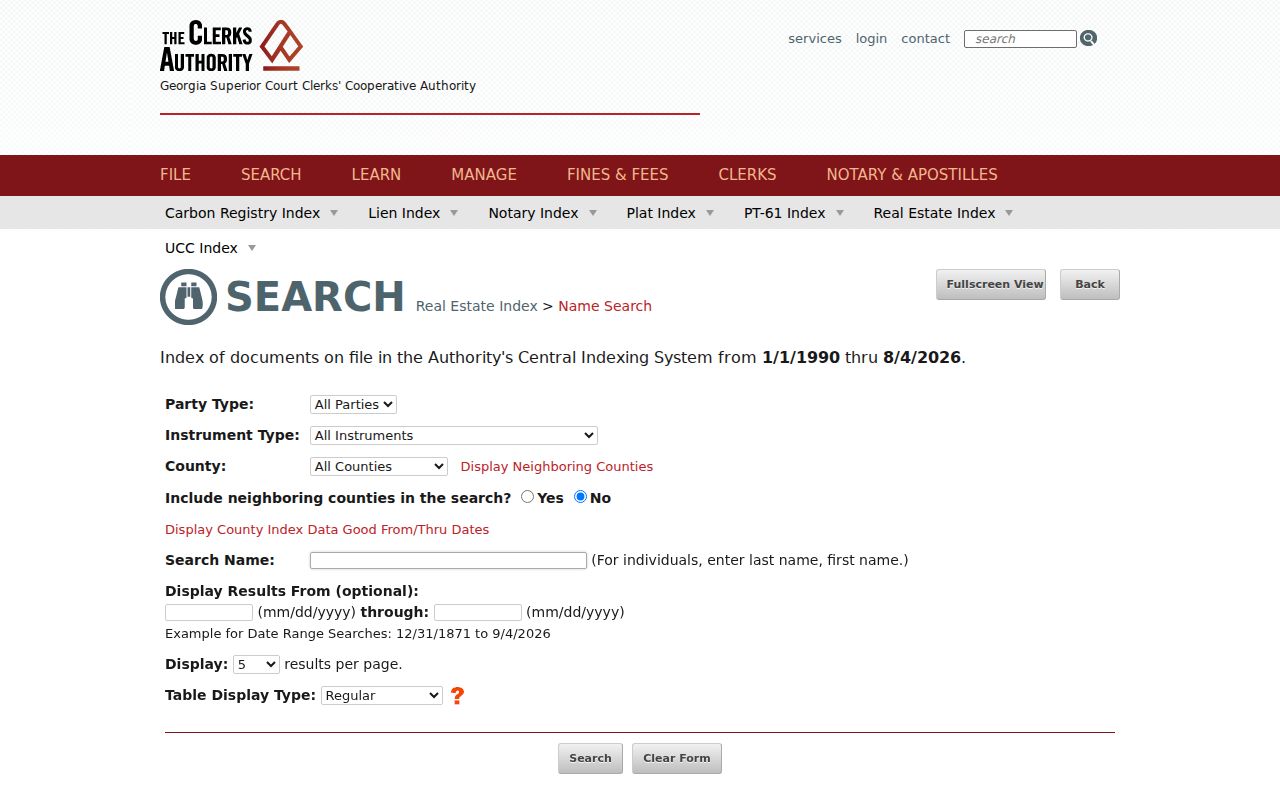
Online coverage starts later. The GSCCCA index opens in 1990 while the Liberty Clerk's in-office digital records reach back to 1976, so a blank web result never ends an ownership history.
Recover Older Liberty Property Owners
When the chain leaves the live index, older Liberty County owners still surface through the Clerk and the Georgia Archives Liberty County finding item. Archives guidance points to deeds, estates, tax records, Superior Court files, and Probate or Ordinary minutes on microfilm and in the Virtual Vault. That is a deep shelf.
FamilySearch catalog item 343605 holds Liberty deeds and mortgages from 1808 through 1904. Some images require an account or a visit to a FamilySearch Center. Many books lack a name index. Known book and page clues save real time.
Liberty County dates to 1777. Sunbury held the seat first. Riceborough took it in 1797, and Hinesville in 1837, so keep old place names as clues rather than converting every record to modern Hinesville.
Newspapers and census schedules help too. The Digital Library of Georgia, Georgia Historic Newspapers, and released federal census schedules can place a named owner in a time and community. A census residence proves nothing about land, so refine names and dates there before returning to the deed books.
Bridge Liberty Estate Chain Breaks
A death breaks the tidy pattern. Search probate for a will, administration papers, executor or administrator authority, heirs, and a later estate deed that moves the Liberty County land out of the estate. A death certificate proves timing, not title.
Subdivision changes break chains too. Search the GSCCCA plat index by name, developer, surveyor, district, land lot, and date. A plat connects lot labels, common areas, and rights-of-way, but the deed still names the owner of record. Never treat the plat as a deed.
Note: Liberty County records show no courthouse fire or destroyed deed book, so a broken chain needs another explanation.
Mark Liberty Ownership Gaps
Gaps happen. An unscanned deed book can hide a link in the chain, and so can a name spelled three ways. An unindexed transfer or a parcel split can hide a link too. Trusts and estates do the same. The Old PIN and Old PIN2 fields in Liberty County property records can bridge modern and former parcel identities. Check them before assuming a gap is real.
When a step will not resolve, mark it plainly as unresolved. Log the names, dates, indexes, and repositories you already checked. A census address or an old tax roll can point the next search in a useful direction. Neither one counts as a deed transfer, though. Keep it out of the chain itself.
A good worksheet stays reproducible. Record the current PIN, the old PIN, the owner display, situs, district, legal description, and acreage. Add the newest and prior book and page, the plat citation, and the dates of each search. Those fields catch a common trap. Two Liberty County records can share a surname but describe different tracts of land.
Some records sit offline. For those, visit the Clerk counter or file a narrow Liberty County Open Records request. Name the address or parcel number, the book or record class, and the time span. State your preferred electronic format. Georgia agencies generally answer within three business days. Otherwise they explain the timing, cost, and any exemption that applies.
Limits on Liberty Former-Owner Research
Former-owner research has real value. It can document a house's history, trace estate succession, explain how a subdivision formed, and support purchase diligence on a parcel. It is not a title opinion. Liens, easements, remainder interests, or probate authority that never made it into the deed records can still change the legal result in Liberty County.
Lawful use. Trace previous owners for land history and diligence. Never use old names or addresses to track, harass, or harm a living person.
Need a hand locating a particular deed book? Call the Liberty Clerk at 912-876-3625. The hard part of tracing former owners in Liberty County is walking the chain backward and knowing where the record trail runs out.