
Fields Inside Liberty County Property Tax Records
Liberty County splits these tax records between two offices. The Board of Assessors sets and equalizes value, keeps the owner-of-record roll, and rules on exemptions and assessment appeals. The Tax Commissioner then takes over. That office builds bills from the approved digest, collects payments, and works delinquent accounts. Reading both sides prevents a common mistake. An estimated market value is not the amount owed, and it is not the price a buyer actually paid for the parcel.
| Field | What It Shows | Where |
|---|---|---|
| 100% appraised or fair-market value | The assessor's expected-sale-value basis for the notice year | Board of Assessors NOA |
| 40% assessed value | Georgia's assessment level applied to fair-market value | Board of Assessors NOA |
| Exemptions and net taxable value | Relief approved on the account and the amount left subject to tax | Board of Assessors |
| Bill and payment status | Amount billed, payments, and delinquency status | Tax Commissioner |
| Tax district and millage | The jurisdiction context and rates used to calculate a bill | Tax digest and bill |
The annual Notice of Assessment carries several numbers. Returned, previous, current, covenant, and net taxable values each play a distinct role in the calculation. The bill then applies the relevant millage and other lawful charges to the taxable base. None of these figures is a sale price. A deed may cite a PT-61 reference. Family transfers, gifts, estates, partial interests, and nominal consideration can all push that figure far from an open-market transaction.
Liberty County Assessor and Tax Commissioner Roles
Corrections to value, ownership, address, or exemptions go to the Liberty County Board of Assessors. The office sits at 100 Main Street, Suite 1550, Hinesville, and answers 912-876-3568. Assessment materials also list 112 N Main Street, Room 1102 for notice questions. Email works too. Owners can write Tax.Assessors@libertycountyga.gov. That channel helps when PRISYM or the PIN document tool leaves a question open.
Billing runs through the Liberty County Tax Commissioner. Billed amounts go there. So do online payments, delinquency, and tax-sale status. The Hinesville counter is at 112 N Main Street, Room 106; mail goes to 100 Main Street, Suite 1545, or call 912-876-3389. A second counter at 9397 E Oglethorpe Highway in Midway serves the coastal side of the county. The offices do related work. Neither substitutes for the other.
Note: A value correction starts with the assessor, because the Tax Commissioner's office does not appraise Liberty County real estate.
Liberty County PIN and Address Search Channels
The Liberty County Property Information System, known as PRISYM, is the county's address-to-parcel bridge. It searches parcel records, site addresses, and subdivisions. With a current PIN, the county's Official Assessment Documents page opens a Real Property Record Card or a Notice of Assessment. The PIN format is fixed. Examples show three digits, one letter, three digits.
| Search source | Accepted field | Best use |
|---|---|---|
| PRISYM Parcels | Parcel Number or Owner Name | Find the tax key and mapped record |
| PRISYM Site Addresses | Full Address or Full Road Name | Start from a street address or corridor |
| PRISYM Subdivisions | Subdivision Name | Locate a named development |
| Assessment Documents | Real-property PIN | Open a PRC or annual NOA |
Spelling variants help because the search is not exact-only. After a split, combination, or annexation, keep any old PIN fields the system displays. A missing online result does not mean no record exists. For PIN-based records, see the official assessment-document entry screen. The county uses that screen for PIN-based records.
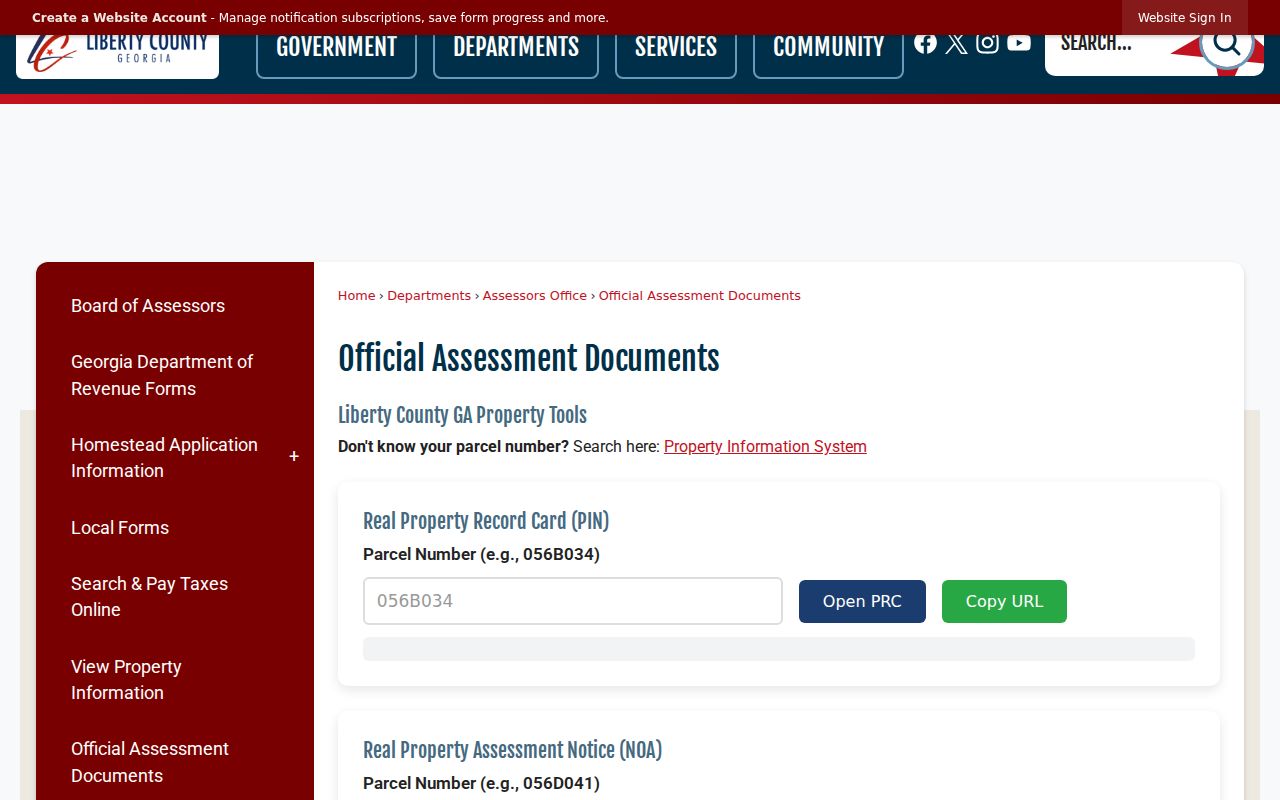
The official assessment-document page lists record cards and notices as separate document choices. Record the type and year of each value.
Trace a Liberty County Tax Bill From Address to Status
A Liberty County property tax lookup should keep both trails together: valuation and payment. The public tax page carries a warning. Its figures come from a working roll that may run slightly behind. Treat the displayed balance as a starting point. The exact amount still matters when a deadline, closing, or delinquent payoff is involved.
- Search PRISYM by full address and save the current parcel number.
- Open the matching PRC or NOA and note the tax year, fair-market value, assessed value, exemptions, and tax district.
- Search the Tax Commissioner's payment portal with the same property key and read the billed amount and status.
- For delinquency or payoff, contact the Tax Commissioner and ask whether advertising, a certificate, or a tax sale affects the account.
- Assessed value
- The statutory portion of fair-market value used in Georgia's property-tax calculation.
- Millage or levy
- The rate set by the relevant county, school, city, or other taxing authority.
- Homestead exemption
- Approved owner-occupant relief that can reduce the net taxable value.
- Tax lien
- A legal claim tied to unpaid taxes, distinct from the ordinary annual bill.
For a fuller explanation of what each value means before it becomes a bill, see the Liberty County property value guide. It explains the numbers plainly.
January 1 Controls Liberty County Tax-Roll Ownership
Ownership on the Liberty County tax roll is fixed on January 1 each year. The annual assessment captures whoever held title on that morning. So a deed recorded in March still transfers the property legally, yet the roll for that same year lists the seller. Neither record is wrong. The deed answers who owns the parcel now; the roll answers who owned it on the assessment date. A Liberty County property tax records search that shows a prior owner right after a closing usually reflects this timing, not a failed deed or a false tax account.
Track four dates whenever a sale closes. Note the deed's recording date first. Then compare the January 1 ownership date, the notice year, and the tax-roll refresh date. Near Hinesville, parcels at the changed city edge add one more wrinkle: an annexation takes effect on its own schedule, so the tax district and city label can shift without any change to the deed or the mailing address. When the entries disagree, treat the recorded deed as proof of the transfer and ask the assessor to walk you through the active roll.
Note: Owner names on Liberty County property tax records reflect the January 1 roll date, not a same-day opinion on legal title.
Liberty County's 100 Percent and 40 Percent Values
Liberty County's assessment notice shows more than one number. The 2025 explanation divides the full fair-market, or appraised, value from the assessed value. Georgia generally assesses property at 40 percent of fair-market value. Approved exemptions are then subtracted to reach net taxable value. Each stage deserves its own labeled, dated figure. Merge them into one vague "tax value". You then lose the reason two official numbers differ.
The Georgia DOR Liberty County tax-facts page offers the state's own assessment guidance. It also provides tax guidance for the county.
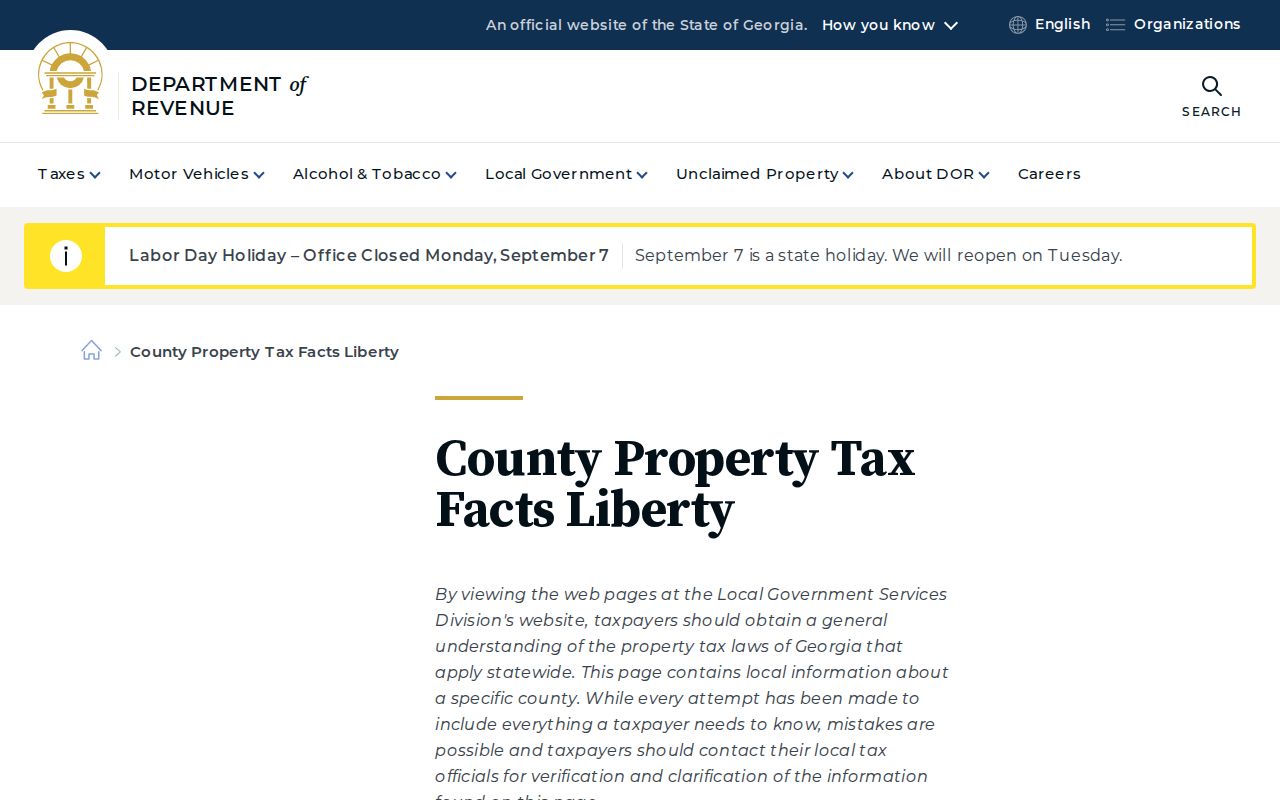
Check the live Department of Revenue page alongside the county notice, since the state overview and the local account record serve different roles.
A returned value is simply the taxpayer's opinion when one was filed. Previous and current values show where things stand in the assessment cycle. Covenant or current-use treatment can introduce a different base. The final bill then reflects the approved digest, applicable exemptions, and the millage that taxing authorities set. That layering is why no bill can be reverse-engineered from a sale price alone.
Keep the labels. Record the year and source beside every Liberty County value; full fair-market, assessed, and net taxable values are not interchangeable.
Exemptions on Liberty County Property Tax Records
Exemption decisions rest with the Board of Assessors, not the payment portal. Liberty County offers homestead relief. It also runs programs for elderly owners, disabled veterans, surviving spouses, and current-use agricultural land. Each program has its own eligibility rules. A parcel may qualify one year and not the next. An exemption line on the tax roll shows what was applied for that year alone. That is not a promise of the same treatment. Treatment can change after a transfer or in a later year.
Before relying on a billed total, ask the assessor about the current application. Ask also about the filing window and proof requirements. Check the exemption lines on the NOA against net taxable value. If an exemption you expect is missing, call the assessor first. Notice language may cite HB 581 or SB 566. But a bill headline does not by itself prove a local exemption applies.
Delinquent Liberty County Tax Accounts and Sale Records
The Tax Commissioner holds the answer to whether a Liberty County account is unpaid. That office can also state the exact amount needed to bring it current. Published collection steps run from delinquency through newspaper advertising, certificates, penalties, and tax sale. An old balance on a working portal proves none of that. It does not show whether a sale is scheduled. It leaves open whether a sale is finished or still open to later rights.
Get the parcel number and tax year straight from the office. Get the principal, penalties, and payment posting there too. Ask for the current payoff, the advertisement, and the sale status the same way. Recorded liens and releases live in a separate track. That track runs through the Clerk and GSCCCA deed records. Never assume an assessor value equals the delinquent claim. The value office and the collection office keep different parts of the evidence.
Request Older Liberty County Bills and Assessment Files
Older material often sits outside the live portal. A prior bill, assessment worksheet, or value-history document starts with the office that created it. The assessor keeps appraisal and exemption files. The Tax Commissioner keeps bills and payment records. When you call or visit, give the parcel PIN, situs address, and owner name for that year. Also include the document type and date span. Liberty County counters are a normal access path, not a last resort.
Check first that the file exists and is nonexempt. If it is, file a targeted Liberty County Open Records request. Georgia agencies generally respond, or explain availability, timing, cost, and exemptions, within three business days. Staff do not have to create a new analysis. Ask for an existing bill, NOA, digest entry, or correspondence by exact year. That works far better than requesting every tax record tied to an address.
Contest a Liberty County Property Tax Assessment
A Liberty County owner can appeal the annual assessment notice on several grounds. Those grounds are value, uniformity, taxability, or exemption treatment. The appeal window lasts 45 days from the notice date. File with the Board of Assessors. Keep proof that your appeal arrived on time. The filing should identify the parcel and the notice year. It should also name the disputed issue, the correction you want, and your evidence. Strong support might include the current NOA, accurate property facts, photographs, a recent arm's-length sale, and comparable assessments. It may also include a professional appraisal when the stakes justify one.
When the Board declines to make the change, Georgia law allows the dispute to move to the Board of Equalization. From there it can go to Superior Court, depending on the route chosen. Procedure and election choices carry real consequences. So read the live notice and the current state instructions before filing. A phone call never substitutes for a filed appeal. Hold on to the envelope or electronic confirmation along with the assessment worksheet.
Appeal window. Liberty County assessment appeals must reach the Board of Assessors within 45 days of the notice date; follow the current notice's filing directions.